NATIONAL MMIW AWARENESS DAY
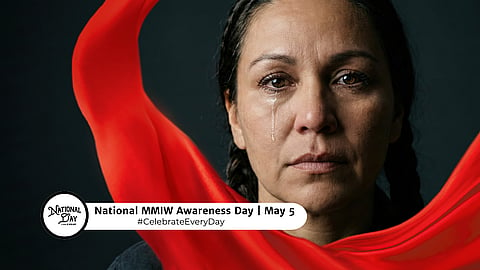
NATIONAL MMIW AWARENESS DAY
National MMIW Awareness Day on May 5 represents the voices that have been silenced and the thousands of Indigenous women who are statistically more likely to experience violence than any other demographic. This is our call to for better data collection, stronger legal protections, and increased community safety.
#NationalMMIWDay and #NoMoreStolenSisters
National MMIW Awareness Day was established to bring national attention to the crisis of violence against Indigenous women. It's a day to honor the memory of those lost and supports the families still seeking justice.
The Missing and Murdered Indigenous Women (MMIW) crisis are often described by advocates as a "hidden epidemic." Jurisdiction overlaps between tribal, federal, and state/provincial law enforcement make it difficult to gather data and report statistics. The top reasons why are:
Confusion about jurisdiction on tribal lands, it is often unclear whether local, tribal, or federal police have the authority to investigate, leading to "lost time" in the critical first hours of a disappearance.
Lack of media coverage for cases involving missing Indigenous woman is often minimal or almost non-existent.
Systemic issues, such as poverty, lack of housing, and the legacy of the residential school systems have created vulnerabilities that traffickers and predators exploit.
Statistics In the U.S.
According to the National Institute of Justice, more than 4 in 5 Indigenous women (84.3%) have experienced violence in their lifetime.
On some reservations, Indigenous women are murdered at a rate 10 times higher than the national average.
As of 2016, the National Crime Information Center reported 5,712 missing American Indian and Alaska Native women and girls, yet the U.S. Department of Justice’s federal missing persons database (NamUs) only logged 116 of those cases.
Homicide is the third leading cause of death for Indigenous women between the ages of 10 and 24.
Statistics in Canada
Indigenous women represent roughly 16% of all female homicide victims even though they make up only 4% of the total female population.
Indigenous women are 12 times more likely to go missing or be murdered than any other demographic in Canada.
As of 2019, the National Inquiry into MMIWG concluded that the thousands of disappearances and murders over the last several decades constitute a "national genocide."
While official Royal Canadian Mounted Police (RCMP) reports documented 1,181 cases between 1980 and 2012, Indigenous advocacy groups believe the true number is closer to 4,000.
(National MMIW Awareness Day is known as MMIWG2S in Canada to include MMIWG to include women, girls and Two-Spirit individuals.)
HOW TO SHOW SUPPORT FOR #MMIW
Wear Red and encourage followers to wear red clothing or a red ribbon to show they stand with Indigenous communities. Many communities hang empty red dresses in public spaces or parks to symbolize the "missing" who should be there.
Raise awareness by sharing statistics from organizations like the National Indigenous Women’s Resource Center (NIWRC).
Support local support by sharing information about missing Indigenous women in your community.
Consider volunteering and showing support for for families currently searching for loved ones.
Share information about missing Indigenous women and events in your community using the hashtags #MMIW, #NoMoreStolenSisters and #NationalMMIWDay on social media.
STORY BEHIND NATIONAL MMIW AWARENESS DAY
Our research shows National MMIW Awareness Day on May 5th was created to honor the birthday of Hanna Harris, a member of the Northern Cheyenne Tribe.
Hanna disappeared on July 4, 2013, after she didn't return home after 4th of July celebrations. When her family reported her missing, they were reportedly met with "stonewalling" from law enforcement. Undeterred, the tribal community and her family organized their own massive search parties, raised reward money, and held rallies.
Five days after Hanna went missing, her body was found in a remote area. Sadly, because of the delay in finding her, the evidence was severely compromised. It was eventually determined that she had been sexually assaulted and murdered. Thanks to her family's determination to bring justice for Hanna's death, two individuals were eventually convicted and sentenced to prison for in 2015.
In 2017, the U.S. Senate officially designated May 5th as the National Day of Awareness for Missing and Murdered Native Women and Girls specifically to honor Hanna’s birthday.